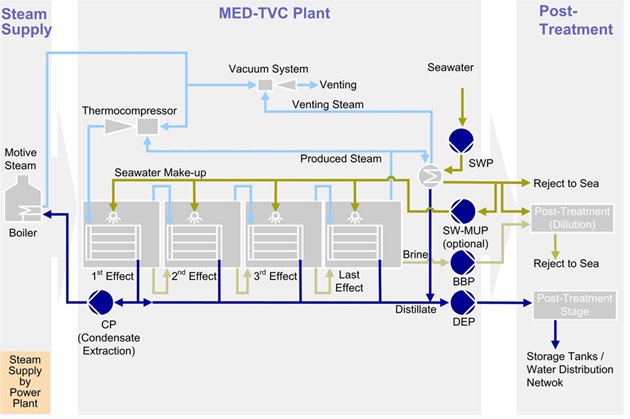




Multi-Effect Distillation (MED) with Thermal Vapour Compression (TVC)
Introduction:
Multi-Effect Distillation (MED) is a thermal desalination process widely used for the production of high-quality potable water from seawater. The process is based on the principle of evaporation and condensation under reduced pressure, allowing seawater to boil at progressively lower temperatures across multiple stages (effects).
When integrated with Thermal Vapour Compression (TVC), the process achieves improved thermal efficiency by recovering and reusing low-pressure vapour within the system.
Process Principle:
MED operates through a series of evaporators, referred to as effects, each maintained at a lower pressure and temperature than the previous one.
- In each effect, seawater is heated and partially evaporated
- The generated vapour is used as the heating medium for the subsequent effect
- This cascading reuse of vapour significantly reduces the overall energy consumption
The process is driven by motive steam, typically supplied from a boiler or power plant or from a source of Waste Heat.. This steam provides the primary thermal energy required for evaporation.
The integration of a thermocompressor (TVC) further enhances efficiency by entraining low-pressure vapour from downstream effects and recompressing it using high-pressure motive steam.
Main Process Components Steam Supply System:
1. Thermocompressor (TVC)
- Uses high-pressure steam to entrain low-pressure vapour from the last effects
- Recompresses the vapour to an intermediate pressure
- Recycles it as a heating medium for the first effect
2. Condensation and Distillate Collection
As vapour condenses on heat transfer surfaces:
- It forms distillate (freshwater)
- The distillate is collected and routed via the distillate extraction system
3. Brine System
As evaporation progresses:
- Salt concentration increases
- Residual brine is discharged via the brine transfer pump
4. Distillate Extraction and Post-Treatment
The produced distillate:
- Is of very high purity (low TDS)
- Is collected and pumped via the distillate extraction pump
Post-treatment typically includes:
- Remineralization
- pH adjustment
- Disinfection
Before storage and distribution.
5. Condensate Recovery
Condensed steam from the process is recovered and returned to the boiler via the condensate extraction system, improving overall plant efficiency.
Operating Conditions
Typical MED-TVC operating parameters:
- Top brine temperature: 60–70°C
- Number of effects: 6–16
- Specific thermal energy consumption: ~50–70 kWh(th)/m³
- Electrical consumption: ~1.5–2.5 kWh(e)/m³
Advantages of MED-TVC
- High reliability and robustness, especially for high-salinity or challenging seawater conditions (e.g., Red Sea, Arabian Gulf)
- Low fouling tendency compared to membrane systems
- Long equipment life
- Ability to utilize low-grade or waste heat
- Stable operation with consistent water quality