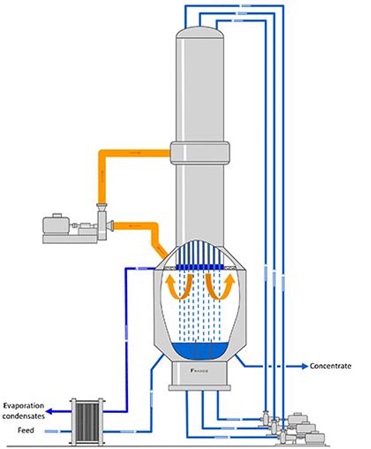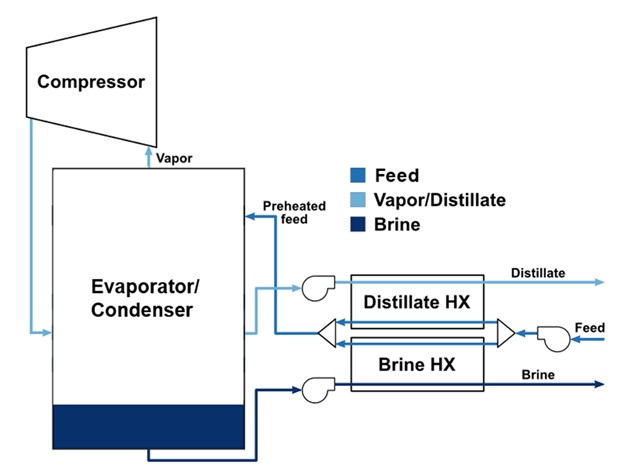




Mechanical Vapor Compression (MVC) is a thermal desalination technology in which water is evaporated at low pressure and the generated vapor is mechanically compressed to a higher pressure increasing its temperature. Releasing the latent heat through condensation drives the further evaporation.
Unlike conventional thermal systems (e.g., MED), MVC:
- Does not require external steam
- Relies mainly on electrical energy for the compressor
- Achieves high energy efficiency through internal heat recovery
Main Equipment:
1. Evaporator/Condenser
- Usually falling film or forced circulation
- Materials: –
1) Titanium (seawater)
2) Duplex stainless steel
2. Compressor
- Largest energy consumer
- Typically centrifugal type
3. Heat Exchangers
- Plate or shell-and-tube
- Functions: –
1) Feed preheating
2) Energy recovery
4. Pumps
- Feed pump
- Brine circulation pump
- Distillate pump
Typical Performance Parameters
Parameter Typical Range
Capacity: 100 – 5,000 m³/day (per unit)
Recovery 30 – 50% depending on feedwater salinity
Specific Energy Consumption (SEC) 7 – 15 kWh/m³
Product Water Quality < 10 ppm TDS
Operating Temperature 60 – 90°C
Advantages:
- Latent heat is reused
- No external steam required
- Robust to variations in feed quality
- Handles: –
1) Feed with high Handles: salinity
2) Feed with high fouling potential
- High purity water with near-distilled water quality output (<10 ppm TDS)
- Compared to RO systems
1) Low chemical dependency
2) Easy to operate and maintain
3) Lower requirements re feed pretreatment